
Interview with John Dupuis
Nov 27, 2015On Wednesday I sat down with John Dupuis, the head librarian of the York Steacie Science Library, to talk about what’s happening in the open science world, and to get some feedback on a few of my ideas so far.
As an active proponent of open science, he shared with me a number of projects that leverage similar ideas as my project.
Talking with John led me to two conclusions. First, the modularity of the initiative seems to be an important factor in the success of online collaboration. A single research question must be broken down into manageable components that individuals can come in and contribute to. Github accomplishes this through the splitting of work into issues and pull requests, with the former being low-effort, the latter being high-effort.

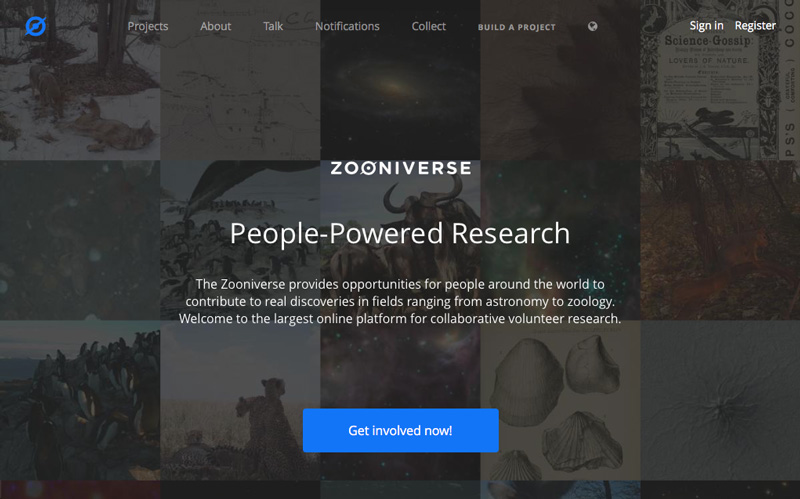
Zooniverse, a web-based tool for citizen participation in science.
A successful example of this in the sciences is Zooniverse, a project to enable citizen contributions to science by performing menial tasks that can’t easily be automated. Zooniverse has been very successful, I think in part because of how it makes contribution very easy and well-defined.
This echoes the real world, where research groups often collaborate by breaking down questions into discrete modules of work, owned by individual researchers. Sometimes these modules are more technical or task-oriented in nature (eg. gathering data, writing the paper), and other times they’re more abstract and intellectual (eg. “analyzing the data”). But the discrete roles help the work come together, even on papers with thousands of contributors.
Second, the tools and artifacts used to work through problems varies widely between disciplines. The Polymath Project was “straightforward” in the sense that mathematics is one of the “cleanest” disciplines of inquiry: no external artifacts are needed, only words and calculations to develop ideas. This is different from fields like chemistry or biology, where much of the action takes places through lab trials and physical measurements.
Either this tool needs to focus on a single discipline, or find ways of integrating the different workable pieces of information for different disciplines (maybe like Slack‘s notion of integrations?) The former is probably preferrable.